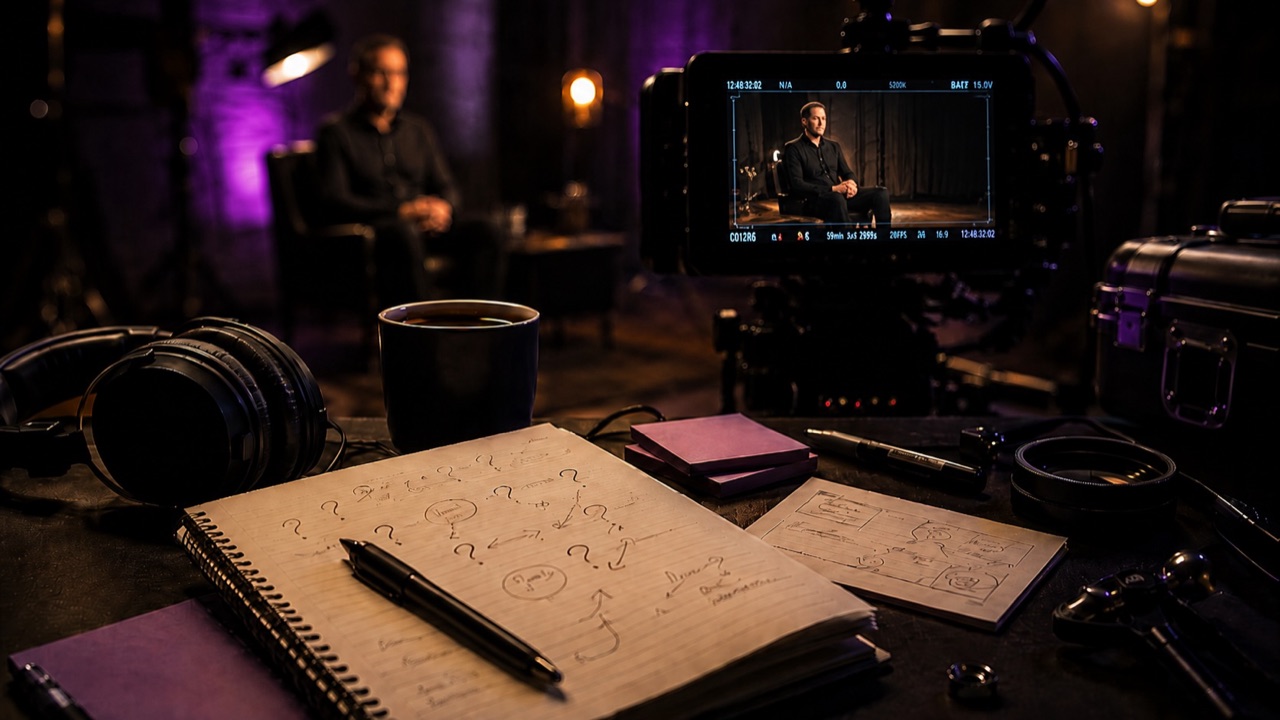
In how to read a production company's reel we said the real test of interview footage is whether it sounds natural or coached. Here is the part that surprises people: it is almost always both. Unless you are making a very specific kind of fly-on-the-wall documentary, every interviewee is going to be coached. They should be coached. Most people are not comfortable on camera, and leaving them to figure that out alone is not authenticity. It is neglect. The true test is whether the coaching reads as coaching in the final piece, and that comes down to one person: the producer.
The best producer is a coach
A good producer works the way a good coach does. They prepare their subjects, settle their nerves, and know when to step in and when to stay out of the way. The goal is never to script a person. It is to build the conditions where a real person can find their own thoughts and deliver them clearly. A well-coached interview does not sound coached. It sounds like the most articulate version of the person you are working with, whether they are a professional camera personality, a subject matter expert, a knowledgeable employee, or someone you grabbed on the floor at a trade show.
That work is a role, not a task someone absorbs between lighting setups. On a stripped-down crew, it is worth asking who is holding it, or whether anyone is. We covered that tradeoff in the one-person crew.
When the client wants to run the interview
Some clients want to conduct the interviews themselves. Some have ample interview experience, or come from journalism or PR backgrounds. Great. Welcome to the crew. Others do not realize their own inexperience, because being a subject matter expert in your field does not make you a brilliant interviewer. Interviewing is an art with its own rhythm, and most of it happens while you are not talking: staying engaged, listening closely, and resisting the urge to fill space.
Letting the moment breathe
When a subject gets emotional answering a question, the skilled interviewer lets the moment pass at its own pace after the answer ends. A few seconds, or as long as it takes. The alternative, "we have a schedule to keep, let's keep hitting these questions," is tone deaf to the moment and jeopardizes whatever impact it carried. You would not change the subject on a friend who is confessing something wrenching, hard, or sad to you. The same etiquette applies to an interview. A skilled producer knows how to thread that needle.
The silence is deliberate
Some moments on a shoot feel awkward. Cameras are rolling, lights are blazing, everyone on set is watching, and nothing is being said. That silence is there because the producer wants it there. The best moments, the project-defining moments, often happen in exactly that space, right where the logical brain insists something should be happening and that everyone is burning daylight. You are not burning daylight. You are capturing an authentic moment: the subject catching their breath, catching up to their own thoughts, and discovering they have something genuinely thoughtful to add that was not in the playbook.
A plan with room in it
A plan is a good thing. Pre-production is where most of a shoot's quality is decided, and interviews are no exception: the research, the question design, and the schedule all happen before anyone sits down. The playbook exists because most people are not comfortable on camera. But a good plan includes flexible moments where spontaneity and feeling can happen, where honest reactions have somewhere to land. Especially when you have a non-camera-trained subject in front of the camera, giving yourself room to maneuver within your plan is paramount to your success.
A skilled producer is doing two jobs at once here. They are helping the subject feel as comfortable as possible in the world's least comfortable situation, and they are reading the person sitting opposite them. You have a list of questions. Sitting in front of your computer in your office, this order and these questions did the job. But in the room on the day, the subject is giving you something different than you expected, or took you somewhere unanticipated, and it is working. The skilled producer can rearrange the sequence of questions, or pull a thread that is not on the script, in the moment, because they can feel that this is the right move with this particular person.
Create that environment and everyday people find their thoughts and their voice and hand you soundbites you could never have scripted. The best plan takes you up to the moment where you ask the first question. Then the best plan is no plan.
Lean on your producer
So when you hire a production company, ask who is producing, and then let them flex those well-toned interview muscles. Let them prep your people, run the room, and hold the silences. A great producer can interview anyone about anything, because the skill is not knowing the subject. It is reading people. If your next project runs on real people talking on camera, that is where we excel. Let's chat.