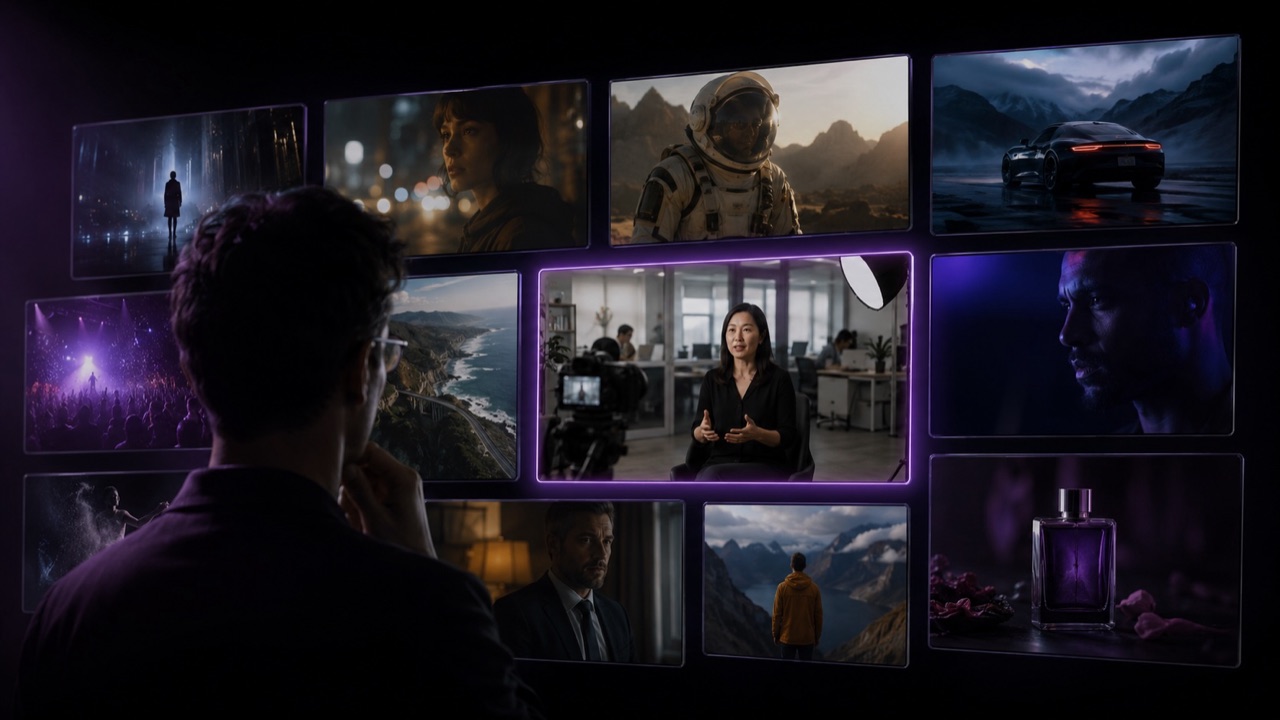
You have narrowed the search to a few production companies, watched their reels, and they all look good. That is not much of a filter, because looking good is the one thing every reel is engineered to do. A reel is a collection of a company's best moments: the strongest three seconds from each of their strongest projects, often gathered across years of work, cut to music chosen to make it land. It shows you the ceiling. It does not show you the typical Tuesday.
So the question to bring to a reel is not "is this good?" It is a narrower one: does this reel contain work like the thing I am asking for?
Match the format first
Production skill is not fully transferable across formats. A company that cuts a stunning thirty-second spot reel is demonstrating a real skill: compressing an idea into a few beats, making every frame count. That is not the same skill as holding an audience through a six-minute interview-driven piece, where the work is in the questions asked off camera, the way an answer gets shaped in the edit, and pacing that survives without a beat drop every four seconds.
The reverse is also true. A team with a deep bench of thoughtful long-form work may not be the strongest choice for a kinetic product spot. Neither company is worse. They are practiced at different things, and the reel tells you which.
So watch the reel with your project in mind. If you are commissioning a corporate piece built on interviews with your own executives, look for exactly that in their work: real people who are not actors, talking on camera, in pieces that hold together at full length.
Weigh the constraints, not just the images
Two shots can look equally polished and come from completely different jobs. A frame from a controlled set with professional talent, art department, and a full lighting package tells you the company does well with resources. A frame that clearly came from a working office, with real employees, a conference room, and a schedule built around people with actual jobs, tells you they do well under the constraints your project will probably have.
If your shoot is the second kind, the second kind of work is the evidence that matters. Making an office look cinematic between meetings is its own craft, and a reel full of staged perfection does not prove a company has it.
Ask to see full pieces
A montage hides length. Reels are cut from peak moments precisely because the peaks are the most persuasive part, but your audience will not watch a montage. They will watch a complete video, start to finish. So once a reel has caught your interest, ask for two or three finished projects in your format, and watch them whole.
At full length you learn what the reel cannot tell you: whether the story actually holds, whether the interviews sound natural or coached, whether the audio and color stay consistent past the highlight shots, whether the piece earns its runtime or pads it. Those qualities, the ones we covered in what makes a video look expensive, only show themselves over minutes, not seconds.
If you can't find your project in the reel, ask
Sometimes the answer is simply not there. The reel is strong, but nothing in it matches your format, your constraints, or your scale. That is not automatically disqualifying. Production companies put their most eye-catching, exciting, big-budget projects in their reel. Because of course they do. They are trying to grab your attention and stand out in a crowded field of talented craftspeople. There is a well-worn saying in the production world: "some jobs are for your reel, and some are for your meals." For a majority of production companies, the bulk of their work falls in the second category. They just do not advertise it. That does not mean they have not done a ton of work just like what you are looking for.
So ask directly: "Have you made something like this, and can I see it?" A good company will either show you relevant work or tell you honestly that this would be a first. A company confident enough to say the second is telling you something valuable about how they will communicate for the rest of the project.
The reel is half the comparison
Reading reels and reading quotes are the two halves of the same decision. The reel tells you whether a company has done work like yours; the quote tells you what they plan to do this time and what it costs. We covered the other half in how to compare video production quotes, and the broader questions worth asking in what brands should know before hiring a video production company.
If you are sizing up reels for an upcoming project, our work is organized by category so you can go straight to the format you are hiring for. If you do not see something close enough to your project, ask us. We would rather show you the genuinely comparable piece than let the highlight reel do the talking.