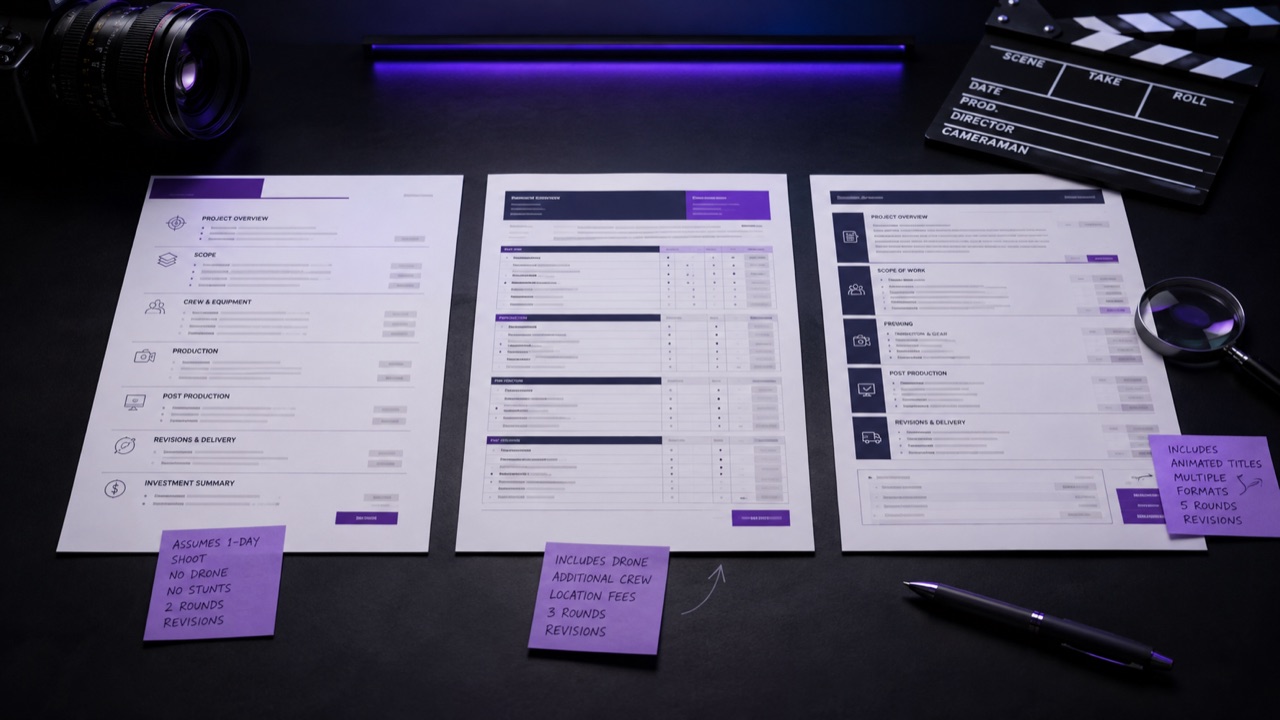
You wrote one brief, sent it to three production companies, and got back three quotes that barely resemble each other. One is a single line item. One is four pages. One sits somewhere in the middle and costs noticeably more than the cheapest.
The natural instinct is to treat the number at the bottom as the comparable part. It usually is not. In production, the price is downstream of a hundred assumptions the quote may or may not spell out, and the cheapest bid is frequently cheapest because it assumed less work, not because it found a more efficient way to do the same work.
Here is how to read quotes side by side so you are actually comparing the same project.
First, check whether they scoped the same project
The most common reason quotes diverge is that the brief left room for interpretation, and each company filled the gaps differently.
Look for whether each quote states:
- How many shoot days, and how long a day is assumed to run
- How many locations, and whether travel between them is inside or outside the price
- How many final deliverables, including cutdowns, vertical versions, and captioned variants
- Runtime for the main piece
- How many rounds of revisions are included, and what happens after those are used
- Who provides what: talent, script, locations, permits, music licensing, product, wardrobe
If one quote assumes one shoot day and two deliverables and another assumes two days and six deliverables, you do not have a price difference. You have a scope difference wearing a price difference's clothes. Send the same follow-up questions to everyone and re-read the numbers afterward.
Read the crew line, not just the crew number
Quotes often list crew as a headcount or a flat "production crew" line. That tells you very little. What matters is which roles exist and what each person is being asked to hold at once.
A three-person crew where one person runs camera while a second handles audio and a third handles lighting is a different day from a three-person crew where one person does all three and two others are handling logistics. Both are legitimate setups. They are not the same risk profile, and the difference shows up on screen in ways that are hard to fix later. We wrote about that tradeoff in detail in what a one-person crew is really saving you.
So when a quote is meaningfully cheaper on production, find out whether the savings came from fewer roles or from a genuinely leaner plan. A crew that is deliberately right-sized around fewer setups and more time per shot is a reasonable way to save money. A crew asked to do everything a larger crew does with fewer hands is a different proposition, and you should be told which one you are buying.
Look for pre-production as a real line item
If a quote goes straight from "kickoff call" to "shoot day," ask what happens in between. Pre-production — creative development, scripting, shot lists, interview questions, location planning, scheduling, logistics — is where most of the quality of the final piece is decided, and it is work whether or not it appears on the invoice.
A quote that shows pre-production explicitly is not padding. It is telling you where the thinking happens. A quote that omits it entirely is either absorbing that cost somewhere else or planning to do less of it, and it is fair to ask which. Our pre-production checklist covers what that phase should actually include, and why pre-production is where production value is won explains why it moves the finished result more than gear does.
Post-production is where quotes hide the most
Editing is the phase clients have the least visibility into and where estimates vary the most. Two "editing" lines can mean very different amounts of work.
Ask what the post number covers:
- Assembly and story edit, versus a straight cut of the best takes
- Color grading, and whether it is a correction pass or a graded look
- Sound design and audio mix, versus dropping music under the dialogue
- Motion graphics and titles, and whether they are custom or template-based
- Music licensing, and whether the license covers the platforms and duration you actually need
- Captions, subtitles, and platform-specific exports
Audio and grade in particular are the phases that separate work that reads as premium from work that reads as homemade, which is why they are worth protecting when the budget tightens. We broke down those markers in what makes a video look expensive.
Ask what happens when something changes
No project ever goes exactly according to plan. A location falls through, an executive's availability moves, a stakeholder asks for a different opening after seeing the first cut. What separates a comfortable project from a painful one is usually how the quote handles change, not whether change happens.
Worth asking before you sign:
- What triggers a change order, and how are overages calculated?
- What is the policy on overtime past the assumed day length?
- What happens if a shoot day is postponed or cancelled, and how close to the date does that matter?
- Are additional revision rounds billed hourly, or as a fixed round?
- Who owns the raw footage and the project files when it is over?
A company that answers these plainly is showing you how it operates. Vagueness here is its own kind of information.
When the cheapest quote is the right answer
If a company scoped the same days, the same crew roles, the same deliverables, and the same post work, and simply runs a leaner operation or wants the project, that is a real advantage and you should take it.
The point is not that cheap is bad. It is that cheap is only meaningful once you have confirmed the two quotes describe the same work. Most of the time, when you normalize scope across bids, the spread narrows considerably — and the one that stays low after normalization is either offering you something the others are not, or leaving something out that nobody has named yet. Either way, you now know which conversation to have. If you are still building the budget itself, our corporate video cost guide covers what drives the number in the first place.
Final thought
A quote is a document describing a plan. Comparing quotes is really comparing plans, and the cheapest plan is only the best deal when it is the same plan. Normalize the scope first, ask the boring questions about crew, post, and change orders, and the right choice tends to become obvious without anyone having to talk you into it.
Weighing quotes for an upcoming project and want a straight read on what you are actually comparing? Contact Cloud Gate Productions — we're happy to walk through scope with you, whether or not we end up being the ones who shoot it. You can also see the full range of our video production services, browse our corporate work, or read what brands should know before hiring a video production company.