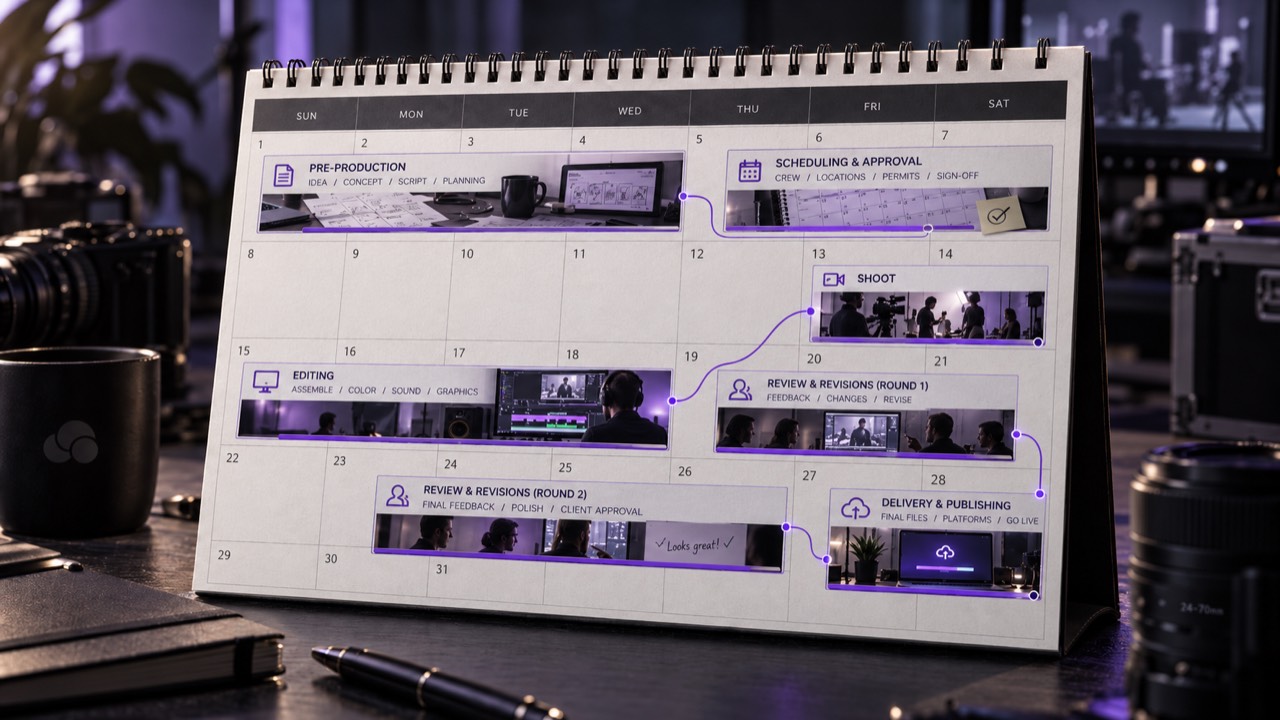
Because "it depends" isn't a helpful answer. Here's the inside baseball on how the process works and what you can do to get from "let's make a video" to posting the final product.
"How long will this take?" usually comes right after "how much will this cost?", and the answer most people get is "it depends." That is true, and it is useless. So here is how the process actually works, phase by phase, and what you can do on your side to get from the first conversation to the day the video posts.
A one-day corporate shoot does not produce a finished video the following week. Production is a chain of phases. Each one waits on the one before it, and what they are usually waiting on is a decision. The money side is covered in our corporate video cost guide; this one is about where the time goes.
The shoot is the shortest phase
On a typical corporate project the shoot is one day, sometimes two, and everything around it takes longer. Pre-production runs weeks. Post-production runs weeks. The shoot sits in the middle as the one part with a fixed, visible duration, which is why people anchor on it. A realistic project timeline runs from "let's make a video" to the day it posts, and on that scale a single-day shoot is a small fraction of the whole.
Pre-production sets the pace
Before a crew is booked, someone has to decide what the video is for, who is in it, where it happens, and what it needs to say. Pre-production is where those questions get answered, and it is the phase whose length varies the most, because it depends on how quickly your side can make decisions.
Things that typically sit on the pre-production clock:
- Locking the objective and the audience, which shapes everything after it.
- The script or interview questions, and the review rounds on them.
- Scheduling the people who need to be on camera, especially executives and customers, who tend to offer a window rather than a day.
- Locations, permissions, and access, which can involve people outside your company entirely.
- Crew and equipment booking, which waits on all of the above being settled.
A production company can move fast on its half of this list. The other half is calendars, approvals, and answers, and that is where most timelines actually stretch. If a shoot date feels far away, it is usually because the decisions ahead of it are still open.
The shoot is fixed, and easy to move badly
Once the plan is real, the shoot itself is the most predictable phase. It is also the one that gets moved most often, and every move costs more than a calendar shift. A moved shoot has to re-clear every subject, every location, and every crew member at once, and the more people involved, the harder that gets. Protecting the shoot date is the single most effective thing a client can do for the overall timeline.
Post-production is where the waiting is shared
Editing is real work with a real duration: pulling selects, building the story, graphics, music, color, sound, and delivering in every format you need. Three things push post-production longer than people expect.
Review rounds. Each round of feedback is a cycle: you watch, you consolidate notes, the editor addresses them, you watch again. Three rounds with prompt, consolidated feedback can take less calendar time than one round where notes trickle in from five stakeholders over two weeks. How many people need to sign off, and whether they sign off together, is the biggest variable in post.
Approvals that live outside your team. Legal, compliance, brand, and anyone else with veto power should be identified before the edit starts, while there is still time to build their review into the schedule.
Deliverables. A main video plus a set of social cuts, captioned versions, and platform variants is more edit time than one video. That is often the right call, and it belongs in the timeline from the beginning.
Final approval is the end of the edit, and the video still is not posted
There is a stretch of work between "approved" and "live" that rarely shows up on anyone's calendar. Each platform wants its own export: the right aspect ratio and length, captions burned in or delivered as a file, a thumbnail, sometimes a separate version for paid placement. Then someone on your side has to receive the files, load them where they live, write the post, and schedule it. If the video is tied to a launch or an event, the posting date is the real deadline, and everything above it gets planned backward from that day.
Where a timeline can be compressed, and where it cannot
Timelines can be compressed. Crews can be booked on short notice, edits can be prioritized, and review can happen in a day when everyone clears the time for it. What does not compress well is anything involving people outside the production: a customer's schedule, a venue's availability, an approval chain. So compressing a plan usually means removing options: fewer locations, fewer subjects, one review round with everyone in the room. That can absolutely work when it is decided up front. Our guide to hiring a production company goes into more detail on this.
Events are the clearest case. The date is fixed, the moment cannot be re-shot, and any deliverable that needs to exist right after the event has to be planned before it. We covered why in why event video can't be an afterthought.
What to bring to the first conversation
If you want an accurate timeline, bring the deadline first, and make it the day the video needs to be posted or shown. A production company can work backward from a real date far more usefully than it can estimate forward from "as soon as possible." Then bring the constraints: who has to be on camera and when they are available, who has to approve the final cut, and what has to be delivered where. With those in hand, the timeline becomes a plan. If your project is a corporate piece with real employees on camera, our corporate work shows the kind of project this applies to.
If you have a date in mind and want to know whether it is realistic, ask us. We will tell you what fits, what does not, and what it would take to get there. If you would rather see how the phases fit together first, start with our services.